6. What have you learnt about technologies from the process of constructing this product?
Throughout this coursework project I have developed my skills using both hardware and software used to make films.
Hardware:
Video Camera
Tripod
Pag Light
Microphone
Headphones
Software:
Adobe Premiere Pro
Adobe After Affects
LiveType
Having already used Adobe Premier Pro during my GCSE course, I felt that this time I got more of a chance to edit personally, as we were working in smaller groups and the finished product was longer.
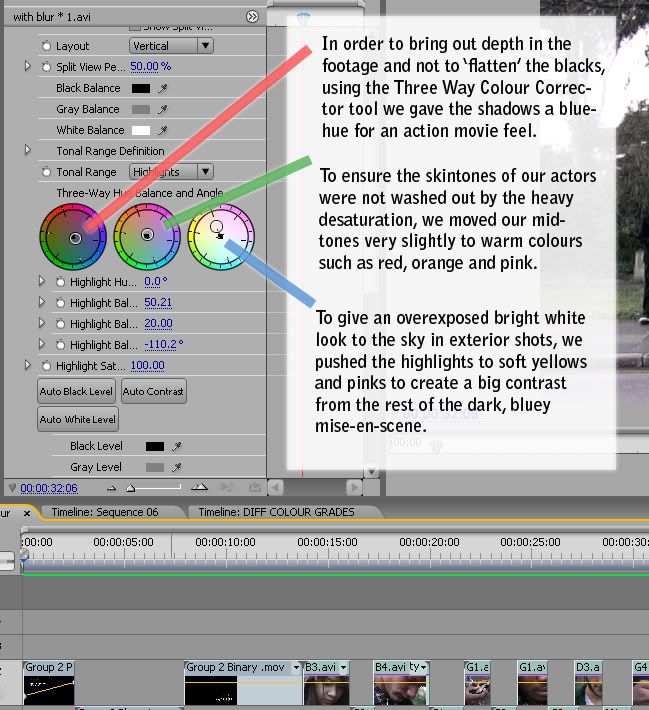
I progressed in my use of sound equalising and non-linear editing and also learnt how to effectively colour grade using ProCamp and Three-Way Colour Corrector which was definitely the biggest challenge, as we were only really using trial and error and we weren’t really sure what colouring we had in mind which made it difficult to know what to do. Here is a video to demonstrate the kinds of effects we tried on our sequence before deciding on the final setting:
We also put in a high-pass sound effect for when Ava removes her headphones to make it sound as realistic as possible before the music stops completely.
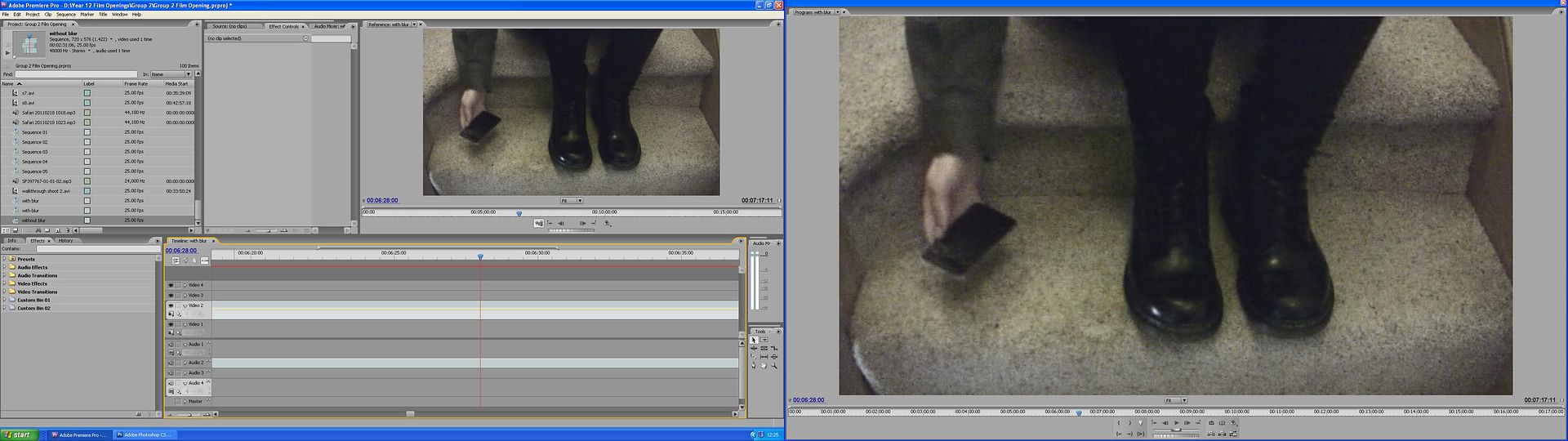
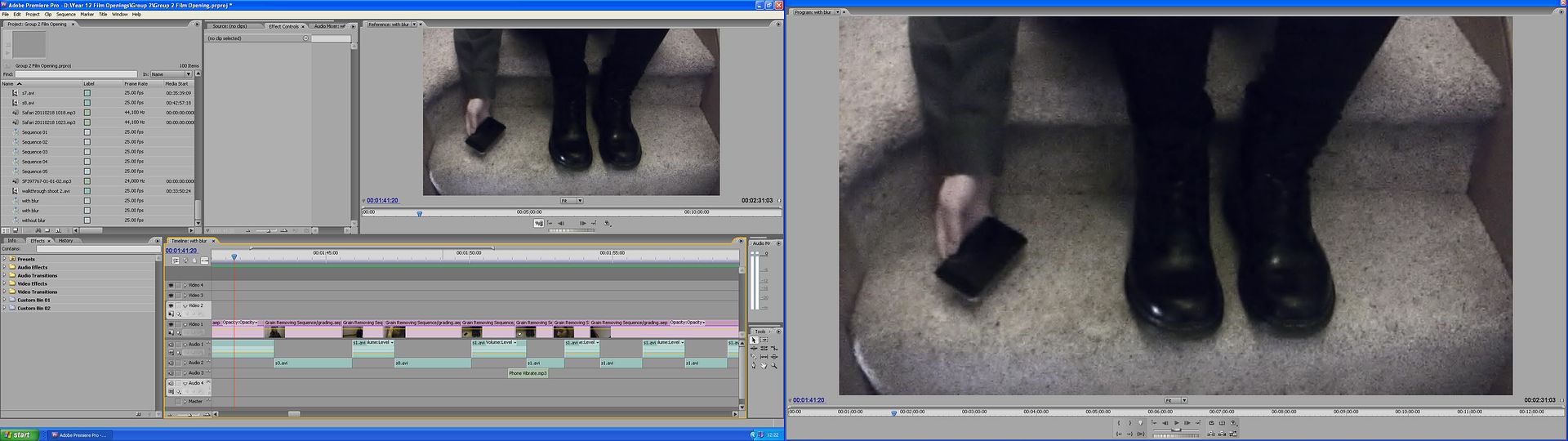
Another important tool we used was the Degrainer in Adobe After Effects, as some of our shots were quite grainy due to low light, so that taught us a valuable lesson to always use the Pag Light even if the shot seems to look okay on the small camera screen.
BEFORE
AFTER
One thing that I think really improved our film opening was using the manual settings on our video camera. We especially liked to use the manual focus, and tried to incorporate several focus pulls into our sequence to give it that cinematic touch.
Here is a video of us practicing using focus pulls:
Certain shots are a little shaky so in hindsight I think we should have made sure to use to tripod whenever possible, because we weren’t intending a handheld effect.
In the future I would like to work on a film with more sound and dialogue, as we didn’t get a chance to do much with the microphone and experiment with settings as our film didn’t require dialogue so all the sound recording was quite straightforward.
Continuity task involving filming and editing a character opening a door, crossing a room and sitting down in a chair opposite another character, with whom she/he then exchanges a couple of lines of dialogue. The task should demonstrate match on action, shot/reverse shot and the 180-degree-rule.
Main Task Brief:
The titles and opening of a new fiction film, to last a maximum of two minutes. All video and audio material must be original, produced by the candidate(s), with the exception of music or audio effects from a copyright-free source.
7. Looking back at your preliminary task, what do you feel you have learnt in the progression from it to the full product?
Creating the preliminary sequence was all about continuity and it was harder than I expected, which taught me to be extra careful when filming for the full product. This helped the narrative make sense and although there were still a few continuity errors, no-one noticed any of them in our screenings as they were minor.
An example of one continuity error we faced
I learnt the importance of a master shot and how it can be cut into and out of several times throughout a sequence to make it clearer to the audience the positioning of all the characters and to set the scene:
Master/Establishing Shot
The prelim task also taught me not to underestimate how long filming can take and to use time properly, as the very simple, short preliminary task took a lot longer than I expected to film, giving me a rough idea of how long our film opening would take. One of the most valuable continuity techniques I learnt whilst creating the prelim task is the 180 degree rule, something I didn’t previously know about.
Whilst selecting footage to use for our prelim task, we noticed that certain shots just didn’t look right together because we had moved over 180 degrees from one shot to the next. This was a good mistake to get out of the way and I made sure not to do the same when filming our opening sequence, in particular during the stairs scene.
As I filmed most of the prelim task, I found that the actors subconsciously moved positions slightly between shots, so whilst directing the main task I made sure to tell our actors to stay as still as possible between shots as to not make the cuts look jumpy.
A basic continuity error in the Prelim Task
Another thing we had to do during our prelim task was a location reccie and walkthrough. This was simple enough as we were just using a classroom at school, but even this posed problems as we could hear the other groups talking through our headphones and we had to share a corridor. It taught us not to just assume we will be able to shoot wherever and whenever we want, and made us more thorough when deciding on locations and testing out sequences for our film opening shoot. This helped us when planning our second shoot for our main task as we did a walkthrough of the extra footage we intended to film at school to flag up any possible problems and to help us decide the shot types for our storyboard:
I am extremely pleased with our finished product and we definitely made the right decision by changing our idea early on in the production process.
I still like our original concept, but in hindsight Mute was definitely a more practical, original idea, and it was nice to do something different as every year most groups make Thrillers.
On location
It was really enjoyable working in my group and we got on really well as we were all on the same wavelength throughout most of the project and any conflicting ideas we did have just brought more suggestions and possibilities to the table. It was great having such an enthusiastic group as we all worked equally as hard to produce a product we could all be proud of.
My group is heading out on our first shoot tomorrow, so here's everything I need to bring along:
Phone
iPod touch
Props to dress the room
Digital Camera & Accessories
Video Camera
Food
Here are some props I brought from my room to help turn Robbie's bedroom into a girl's bedroom.
I also found this t-shirt which I thought we could place somewhere in the bedroom as it hints at Ava's want and need to speak her feelings with a voice she doesn't possess.
My coursework group consists of myself, Charley Packham, Odelia Yu and Robbie Lardi.
At our first meeting, we brainstormed as a group and came up with the starting point of a Psychological Thriller.
We decided it would be best if each of us came up with one initial idea to bring to the next meeting. I liked the idea of the opening sequence consisting of hallucinations, and was inspired by Black Swan, a film I had recently watched at the cinema.
Rivalry between Nina and Lily in Black Swan
Here is my initial idea:
The film:
Psychological Thriller
Protagonist: An overacheiving teenage schoolgirl who strives to be the best at everything she does
She ends up killing her rival in a classroom after the protagonist decides she is too much of a threat to her getting into the college she wants to go to, as the college will only take one person from their school
The opening sequence:
A scene from near the end of the film
Set in a locked classroom
The protagonist is sitting at a desk at the back of the room having just killed her rival (the audience does not know this)
She hallucinates various people appearing in the room and taunging her - e.g. her mother telling her she is a disappointment, her teacher telling her she has failed everything, her rival boasting
Her hallucinations are interrupted by a knock on the door, then a ratlling of the handle and someone calling the protagonist's name
1. Who did you work with and how did you manage the task between you?
My group, 2C, consisted of myself, Philippa Dodi and Sam Szczurek. We brainstormed ideas as a group and came up with the plot for our sequence together. We then split up the tasks to save time, so Philippa drew the storyboard with help from the rest of the group, then I wrote out the shot list while Sam typed up the script. When in production, Sam and Philippa took the acting roles, so I filmed and directed the shots with both of them in, Sam filmed the shots with just Philippa in and Philippa filmed the shots with just Sam in. In post-production, the three of us took turns editing the sequence while the other two helped.
2. How did you plan your sequence? What processes did you use? What theories did you try and take into account?
When planning our sequence, we tried to keep things simple and not try to make it too complicated or elaborate. We used the processes of storyboarding, scripting and brainstorming to develop our ideas. This happened during our group's one hour planning session.
Here is our storyboard (click to enlarge):
Here is our shot list (click to enlarge):
Once we came up with the idea and script for our sequence, we found our location and acted it out to make sure it was feasible and to decide where the camera and actors will be positioned. We made sure to take these theories into account:
Todorov's Theory of Equilibrium - There is an equilibrium with Sam perfectly happy, sitting in his chair, then Philippa comes in and disrupts the equilibrium.
Principles of Continuity - We followed the 180 degree rule throughout our sequence. We actually filmed a shot that broke the rule, and once in the sequence it didn't flow properly and looked confusing so we decided to remove it. We also used match on action, in particular between the two shots of Philippa sitting down, meaning we edited the two together to make it look like one flowing movement. We also incorporated shot/reverse/shot to film the conversation between the two characters, editing together multiple OTS shots to make the conversation flow.
3. What technology did you use to complete the task, and how did you use it?
We used a video camera with a microphone and headphones to check the sound was exactly as we wanted it to be. The microphone allowed us to pick up sound more clearly, especially for the long distant shots. We put the camera on the tripod the whole time, to ensure the shots weren't shaky and that they were level. We then captured and edited our sequence using Adobe Premiere.
4. What factors did you have to take into account when planning, shooting and editing?
The first thing we had to take into account was location, as we had to film in school and we needed a classroom set up to go with our story idea, so we sorted out locations within our class so that our group had the space we wanted. Another important factor was time, as we only had one hour to shoot, so we kept the script short and simple, and didn't put in too many camera positions or complicated shots. We again had the one hour time limit when editing, so we made sure to work efficiently and help each other out so we didn't run out of time. We also didn't try to edit anything too fancily, and kept it simple.
5. How successful was your sequence? Please identify what worked well, and with hindsight, what would you improve/do differently?
I think our sequence was very successful at demonstrating continuity techniques, even though it wasn't particularly original and we didn't take many risks, but that didn't really matter as the point of this task was to show we know the principles of continuity. I think the sequence flows quite well, and nothing looks wrong or confusing to the viewer. This is because we deleted two shots from our sequence during the editing process, as one of them broke the 180 degree rule and one of them didn't quite fit with the match-on-action we wanted, so leaving them in would have made the sequence look wrong. At around 16 seconds in, the sequence does look a bit jolty, as Sam's head moves down then up again quite quickly, so with more time we would have made sure that every shot matched perfectly. I think the OTS shots work very well as shot/reverse/shots, as the conversation looks natural and there aren't really any bits that cut too quickly, and the match-on-action shots when Philippa sits down fit together very well. It probably would have been beneficial if our group had one more member, as the cameraman also had to direct, use the clapperboard and work on sound, which was a little difficult at times, so another person to use the headphones would have been helpful. We also could have made the sequence a bit longer to show a few more continuity techniques.
6. What have you learnt from completing this task? Looking ahead, how will this learning be significant when completing the rest of your foundation coursework, do you think?
From this task I have learnt all of the principles of continuity for filming, and have learnt how to use them in practice. I have learnt to always apply these rules, and to think carefully about whether everything makes sense or not, as we could have saved time filming if we hadn't shot those two clips that we later removed because they didn't work. I have also learnt how the camera microphone works, and how to work with sound on set using the headphones.
This learning will be very helpful when shooting and planning my next coursework task, as I will be able to apply all the principles of continuity I have learnt, and also try to incorporate some of the theories I have learnt, such as Todorov's theory of equilibrium. I think I will also be more productive working in a group for the next task, as we now all know how to use the equipment and how to properly start off and end a shot when filming. Using Adobe Premiere to edit the sequence was also a helpful refresh of everything I learnt about how to use it in year 10, so I will be able to start using it properly straight away in the next task, as everything is now fresh in my mind.
Hi, my name is Jessand I am 17 years old. I am currently in year 12 at Latymer, studying Media, Economics, English Literature and Philosophy/Ethics. I have always loved watching films from a very young age and hope to study Film & Literature at University. Afterwards I want to pursue a career in Media, though doing what exactly I am not sure yet.