BLOGGER TEMPLATES AND TWITTER BACKGROUNDS »

Main task: "Mute" Finished Opening Sequence

Preliminary Task: Finished Continuity Sequence

Saturday, 2 April 2011

Evaluation Question 4

4. Who would be the audience for your media product?

  • Our film is rated 15 and our target audience would be aged between 15 and 25. 
  • The film would be made for a British audience but is hopefully relatable to young people all over the world. 
  • It appeals to both genders, as it is a hybrid of genres, including Action, Drama and Sci-Fi, appealing to males, but the aspirational female hero and the romantic elements will hopefully appeal to young females too.

  • As previously mentioned, the lack of dialogue is unconventional and may put some people off, similar to how many people don’t like watching films with subtitles, but its uniqueness will hopefully attract them into seeing it just so they can make their own minds up.

    A group of target audience members
  • As the style of the film is quite dark and de-saturated, and the plotline isn’t particularly joyful, those who go to the cinema for light-hearted fun will not be the kind of person who comes to see Mute, so our target audience is those who like to see hard-hitting dramatic films that don’t necessarily end happily. 
  • The 15 rating allows us to be more violent and graphic, and although I wouldn’t go as far as to say the film is depressing, it will definitely be quite dark, as the point of the film is to convey how miserable and lifeless a world without speech would be. This makes the film a little more niche than the typical Hollywood action blockbuster.
  • Some adult viewers might be put off by the young main cast but hopefully Mute will become one of those films ‘you just have to see’ as it is quite controversial and could make people look at technology in a completely different way.
  • The overall idea of a parallel universe where we have evolved to be born without voiceboxes is very abstract, and it may just be too strange for some people, but for most people I hope it will be intriguing and if it does well in Britain, we could be looking at a mass release.

Here is an average target audience member:


This is Christy.
  • She is 18 years old and a sixth form college student.
  • She visits the cinema a couple of times a month and enjoys renting and buying dvds to watch with her friends.
  • Her film preferences range from Hollywood blockbusters to lesser known indie dramas, and Mute is the kind of thing that will intrigue her and pull her out of her comfort zone.
  • Her favourite films from the past year were The Social Network and Black Swan.
  • She doesn't mind watching foreign films with subtitles and the Mute premise of having voiceovers and little dialogue doesn't put her off.
  • Her other interests include going to parties and gigs and she likes finding new, up-and-coming bands online.
  • She would probably go and see Mute at the cinema with her friends or boyfriend as something to do one evening.


We showed our film opening to over fifty 15-17 year olds and got them to fill in a questionnaire. Here are a few we received (please press the zoom button to read some of the responses): 
Mute - Filled In Questionnaires

Everyone rated it between 6 and 10 out of 10 and the majority said they would want to see the rest of the film at the cinema.


This shows that we got our target audience right as the feedback was generally positive within our market, and both boys and girls enjoyed the sequence.

Wednesday, 30 March 2011

Evaluation Question 5

5. How did you attract/address your audience? 

  • We used teenage actors to appeal straight away to our core audience of 15-25 year olds, letting them know exactly who the film is centred around.
  • By using actors of white, black and Asian origins we were racially diverse and presented an accurate picture of modern Britain (though of course we soon find out that this isn’t Britain as we know it). 


  • Racial Diversity

    • The seemingly normal setting and characters allow the viewers to suspend their disbelief, as it feels normal to them, except for of course the one big difference: no-one can speak.
    • The music we chose is loud Drum & Bass, a genre popular with young people at the moment, making the film seem modern and exciting. 
    • Action is one of the most popular movie genres so already the film has a wider appeal than if it was, for example, Horror or Comedy.
    
    The most popular movie genres based on weekend gross in 2009


    • As an entirely speechless film would be dull, we would use voiceovers to reflect the silent characters’ thoughts and to allow the viewers to understand and really relate to Ava, otherwise the audience would find it hard to know what she was going through and wouldn’t feel close to her. 
    • The main characters would all be young and attractive to appeal to both boys and girls, and hopefully we would be able to cast a more well-known actor in one of the adult supporting roles to give it a bit more credibility and attract their fan base too.
    • As mentioned in question four, the plotline and hard-hitting themes of the film itself would appeal only to people who enjoy films that make them think and don’t necessarily cheer them up, and the film is not created to please those who enjoy happy, idyllic endings.
    • Although the cast and a lot of the sets are British, hopefully the idea of a loss of speech and culture as a tragedy will translate well worldwide.
    • The love story and fast-paced chase scenes should also help its international appeal, along with the young up-and-coming cast.
    We also tried to incorporate Blumler and Katz's Uses and Gratifications theory:
    1. Information - 'finding out about relevant events and conditions in immediate surroundings, society and the world'. The use of technology is extremely relevant in our current society and our film could make viewers rethink how they communicate with others.
    2. Personal Identity - 'finding reinforcement for personal values'. Viewers may be able to relate to the rebellious teenager characters and see their own personal values in them.
    3. Integration and Social Interaction - 'finding a basis for conversation and social interaction'. Hopefully our film would generate word-of-mouth hype and give everyone something to talk about, especially as the concept is quite controversial. It may also encourage viewers to interact more with their friends after watching it, as the dystopian setting of the film arose due to the lack of face-to-face communication so it might worry people and make them want to talk more.
    4. Entertainment - 'escaping, or being diverted, from problems'. Watching Mute would provide escapism and immersion of the viewer into this dystopian world. The problems of Ava and the other characters may make the audience forget about their problems for a few hours.


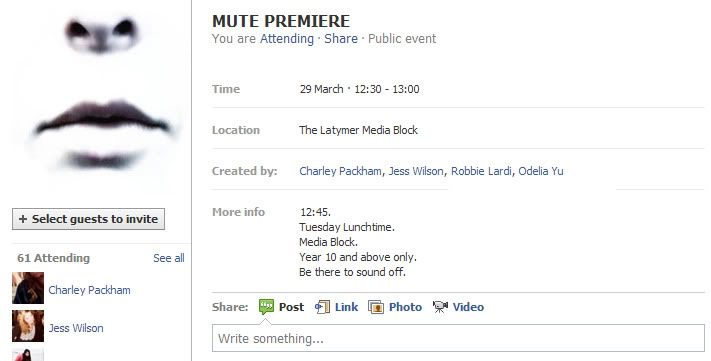
    To attract target audience members to our preview screening we created a Facebook Event and invited everyone aged 15 or older from our school.


    We deliberately put little information on the page, including only vital details like time and location, for enigma and to make our audience come to our screening to see what it was all about.

    Evaluation Question 6

    6. What have you learnt about technologies from the process of constructing this product?

    Throughout this coursework project I have developed my skills using both hardware and software used to make films.

    Hardware:
    • Video Camera
    • Tripod
    • Pag Light
    • Microphone
    • Headphones

    Software:
    • Adobe Premiere Pro
    • Adobe After Affects
    • LiveType


    Having already used Adobe Premier Pro during my GCSE course, I felt that this time I got more of a chance to edit personally, as we were working in smaller groups and the finished product was longer.

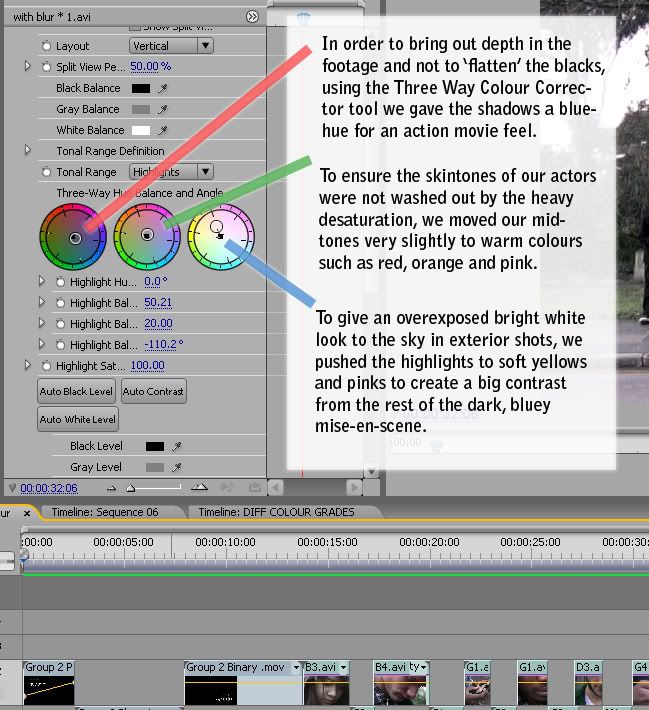
    I progressed in my use of sound equalising and non-linear editing and also learnt how to effectively colour grade using ProCamp and Three-Way Colour Corrector which was definitely the biggest challenge, as we were only really using trial and error and we weren’t really sure what colouring we had in mind which made it difficult to know what to do.
    Here is a video to demonstrate the kinds of effects we tried on our sequence before deciding on the final setting:


    We also put in a high-pass sound effect for when Ava removes her headphones to make it sound as realistic as possible before the music stops completely.
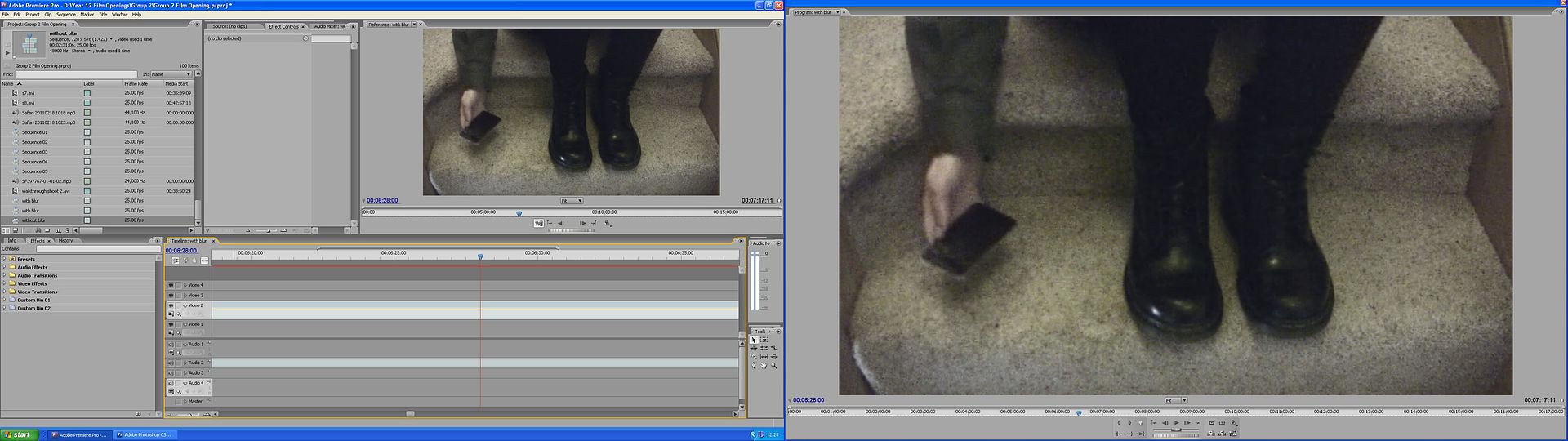
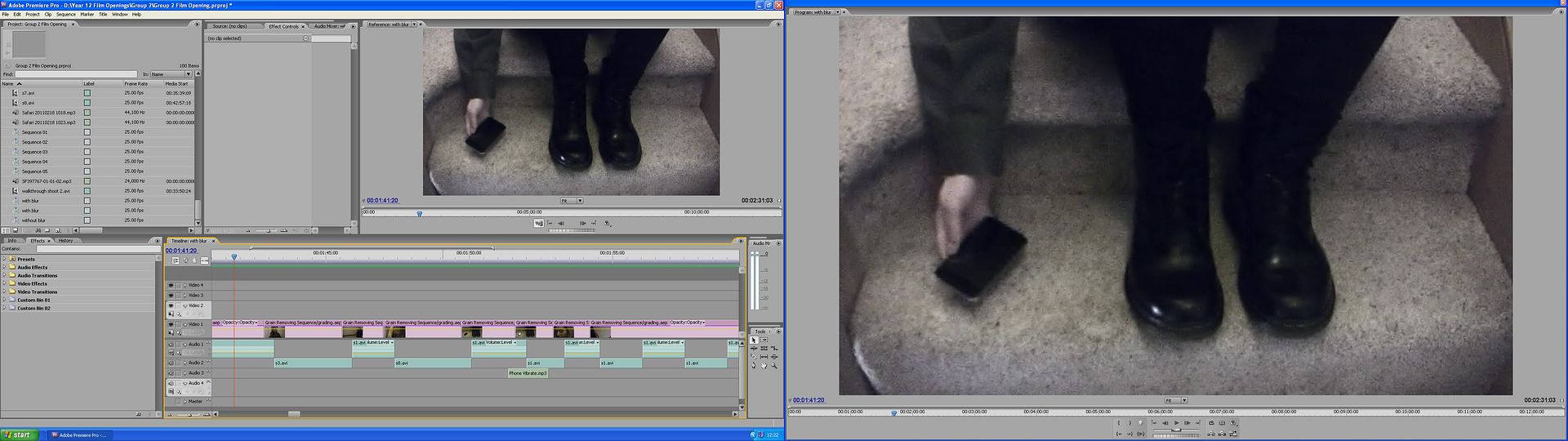
    Another important tool we used was the Degrainer in Adobe After Effects, as some of our shots were quite grainy due to low light, so that taught us a valuable lesson to always use the Pag Light even if the shot seems to look okay on the small camera screen.

    BEFORE

    AFTER

    One thing that I think really improved our film opening was using the manual settings on our video camera. We especially liked to use the manual focus, and tried to incorporate several focus pulls into our sequence to give it that cinematic touch.

    Here is a video of us practicing using focus pulls:


    Certain shots are a little shaky so in hindsight I think we should have made sure to use to tripod whenever possible, because we weren’t intending a handheld effect.
    In the future I would like to work on a film with more sound and dialogue, as we didn’t get a chance to do much with the microphone and experiment with settings as our film didn’t require dialogue so all the sound recording was quite straightforward.

    Evaluation Question 7

    Preliminary Task Brief:
    Continuity task involving filming and editing a character opening a door, crossing a room and sitting down in a chair opposite another character, with whom she/he then exchanges a couple of lines of dialogue. The task should demonstrate match on action, shot/reverse shot and the 180-degree-rule.

    Main Task Brief:
    The titles and opening of a new fiction film, to last a maximum of two minutes. All video and audio material must be original, produced by the candidate(s), with the exception of music or audio effects from a copyright-free source.


    7. Looking back at your preliminary task, what do you feel you have learnt in the progression from it to the full product?

    Creating the preliminary sequence was all about continuity and it was harder than I expected, which taught me to be extra careful when filming for the full product. This helped the narrative make sense and although there were still a few continuity errors, no-one noticed any of them in our screenings as they were minor.

    
    An example of one continuity error we faced
    

    I learnt the importance of a master shot and how it can be cut into and out of several times throughout a sequence to make it clearer to the audience the positioning of all the characters and to set the scene:

    Master/Establishing Shot

    The prelim task also taught me not to underestimate how long filming can take and to use time properly, as the very simple, short preliminary task took a lot longer than I expected to film, giving me a rough idea of how long our film opening would take. One of the most valuable continuity techniques I learnt whilst creating the prelim task is the 180 degree rule, something I didn’t previously know about.

    Whilst selecting footage to use for our prelim task, we noticed that certain shots just didn’t look right together because we had moved over 180 degrees from one shot to the next. This was a good mistake to get out of the way and I made sure not to do the same when filming our opening sequence, in particular during the stairs scene. 

    As I filmed most of the prelim task, I found that the actors subconsciously moved positions slightly between shots, so whilst directing the main task I made sure to tell our actors to stay as still as possible between shots as to not make the cuts look jumpy.

    
    A basic continuity error in the Prelim Task
    

    Another thing we had to do during our prelim task was a location reccie and walkthrough. This was simple enough as we were just using a classroom at school, but even this posed problems as we could hear the other groups talking through our headphones and we had to share a corridor. It taught us not to just assume we will be able to shoot wherever and whenever we want, and made us more thorough when deciding on locations and testing out sequences for our film opening shoot.
    This helped us when planning our second shoot for our main task as we did a walkthrough of the extra footage we intended to film at school to flag up any possible problems and to help us decide the shot types for our storyboard:

    Thursday, 24 March 2011

    Final reflections on my finished opening sequence


    I am extremely pleased with our finished product and we definitely made the right decision by changing our idea early on in the production process.

    I still like our original concept, but in hindsight Mute was definitely a more practical, original idea, and it was nice to do something different as every year most groups make Thrillers.

    On location

    It was really enjoyable working in my group and we got on really well as we were all on the same wavelength throughout most of the project and any conflicting ideas we did have just brought more suggestions and possibilities to the table. It was great having such an enthusiastic group as we all worked equally as hard to produce a product we could all be proud of. 


    Thursday, 10 March 2011

    Research: Popular Action & Drama Films

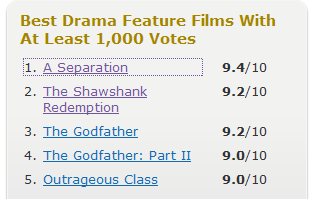
    I looked at IMDB to find out the most popular action and drama films ever released.


    Looking at stills and watching the trailers of some of these films helped me to understand what a good Action/Drama film should look like.

    Saturday, 12 February 2011

    Shoot Number 1 Preparation

    My group is heading out on our first shoot tomorrow, so here's everything I need to bring along:

    • Phone
    • iPod touch
    • Props to dress the room
    • Digital Camera & Accessories
    • Video Camera
    • Food
    Here are some props I brought from my room to help turn Robbie's bedroom into a girl's bedroom.

    I also found this t-shirt which I thought we could place somewhere in the bedroom as it hints at Ava's want and need to speak her feelings with a voice she doesn't possess.