Thank you for taking the time to look around both my individual blog and my Group Blog.
You will find both links to the group blog and the Main teaching blog (which has links to all the other individual and group blogs at my centre) to the right of the page. There is also a list of tags and my blog archive so you can easily navigate my posts, as well as a search bar.
On this blog you will find any independent research I undertook, my individual initial idea and of course my answers to the seven evaluation questions. You can also check out any work I did for my preliminary task, including the evaluation, and view both my finished preliminary task and main opening sequence at the top of this page. I hope you enjoy watching them both, particularly Mute as a lot of hard work was put into it by all four members of my group.
On my Group Blog you will find the work I individually contributed towards the development and production of our opening sequence by clicking on the tag labelled 'Jessica', along with any work the whole group produced together.
All posts are organised chronologically, dated from January up to April of this year. I have posted my evaluation answers in reverse order so you can read them in order from the top to the bottom of the page.
Thanks again and I hope my blogs are enjoyable and interesting to both look at and read.
Tuesday, 5 April 2011
Note to the moderator

Saturday, 2 April 2011
Evaluation Question 1
Genre
We wanted to make our film opening look like an Action/Drama movie by using similar colour grading and lighting, taking inspiration from big action films like The Dark Knight and I Am Number Four.
The mise-en-scene and style of the sequence was really important in getting across genre conventions, as the opening of our film does not have a lot of action in it, emitting the typical features of an action film like guns and fighting, challenging the conventions of other films like the James Bond franchise which often have fast-paced action scenes right at the beginning of the movie.
This clip from The Dark Knight has shadowy lighting and slightly blue tint, which is the effect we wanted for Mute.
We also looked at Action/Sci-Fi films like I, Robot as our film does have some science fiction elements to it because of the focus on technology and a dystopian world. This clip is also quite dark and is graded with a hint of blue.
Here is a selection of stills from Action films we took inspiration from. As you can see, there is a definite running theme for colour and lighting effects.

We didn’t want our film opening to be quite this blue, as it is also a Drama, and we thought the blue tints on a lot of films were a bit over the top.
The way our opening sequence begins straight away with loud, up-tempo music is also typical of the action genre as the audience is captivated and excited as soon as the titles appear.
Narrative structure
Mute has a traditional narrative structure in that is fits quite well with Todorov’s Theory of Equilibrium:

However, we decided to break the conventions and create another disruption at the end of the film, leaving it open to a sequel. Whilst Ava is celebrating with the rest of the nation, we hear the government plotting to kill off Ava and her new boyfriend, planning to cover it up by announcing to the world that these fake voiceboxes are infected and therefore everyone must have them removed again immediately.
Our film is also untraditional as it does not really fit with Propp’s Character Theory:
- Our protagonist Ava is of course the hero.
- Being a girl she does not have a princess to save and instead has two supporting characters, all three of them helping each other out equally.
- One of the boys, Benjamin’s friend, ends up being the victim who is tragically killed by the government, rather than the typical damsel in distress.
- There is no straightforward villain either, but instead a faceless government represented in the film by the trained-to-kill team of guards who are sent out to track the trio and try and stop them from reaching their destination.
The first half of our opening sequence does not use real time editing and instead uses a montage style to first show the people at the bus stop, then to show different parts of Ava’s journey home.
The cross cutting at the beginning of the sequence is deliberately jumpy to create pace and enigma, as the audience does not know who these people are and why they are all engrossed in their phones.

The establishing shot of the bus stop creates a binary opposite between Ava and the other teenagers around her, as they are all looking down at their phones whereas she is staring thoughtfully out across the road, signalling her non-conformity. The second half of the sequence is edited to real time and the pace is much slower, reflecting the monotony of this silent, detached world.
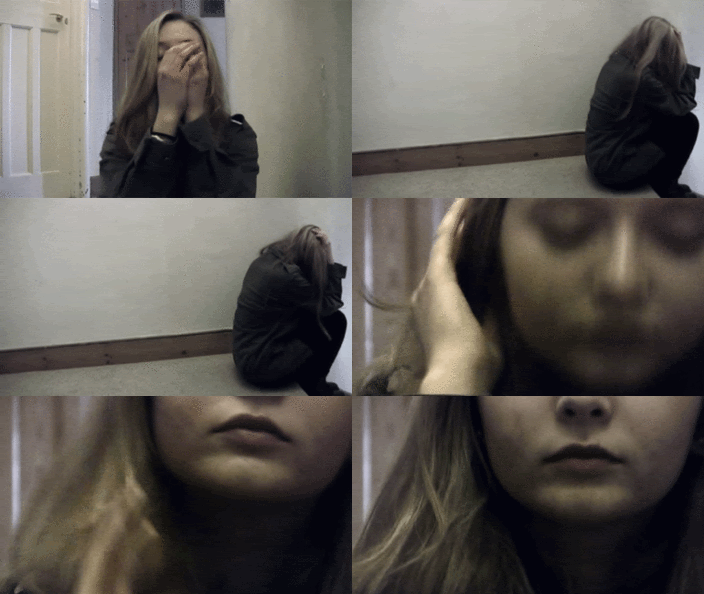
Once inside the house we made sure to stick to the continuity rules.
 |
Form
The typical form of a film opening sequence is to either
- Introduce the characters and plotline in the conventional way, or
- To start at a key point later in the narrative, then jump back to an earlier date to show the events leading up to this point.
Here is an example of a film that starts at the end: The Butterfly Effect, conforming to form (2). The opening sequence is flashforward to an event near the end of the film, confusing the audience and leading them to wonder what happened to cause the protagonist to be in this situation.
As we were not making the entire film, we thought it would be much simpler to use the conventional form, way (1) of starting at the beginning, otherwise our sequence would not work as a standalone media product.
To make things more interesting, we used the enigmatic zoom on the webpage at the end of our opening to make the audience aware of what the rest of the film might be about; sure enough, these ‘scientists’ will be very relevant to the plotline.

It is also a convention of an opening sequence to introduce your protagonist, and as Ava is the only character not engrossed in her phone, she immediately stands out and it is obvious that she is the protagonist even before we begin to follow her home.
We didn’t want to waste screen time by putting all our titles on black screens, so instead we placed most of them over the footage, positioning them discreetly at the bottom of the screen so they are both easy to read yet not distracting. The titles end before the vital parts of the sequence where viewers have to concentrate on something important, for example the news article at the very end, so they don’t miss anything.

Style
As well as wanting the typical stylistic features of high-budget action movies, as our product is meant to be part of a gritty British film, we wanted it to look a little different from these Hollywood blockbusters. We liked the low-saturation, high-contrast, washed out look of British superhero drama Misfits. Here is a clip to demonstrate:
In regards to the editing and pacing of our opening sequence, we wanted it to start off very choppy and fast-paced, cut perfectly to the upbeat high-impact soundtrack. Halfway through the sequence, there is a dramatic switch to the eerie silence inside the house as Ava removes her headphones, incorporating Levi-Strauss’s theory of Binary Opposites: the loud drum and bass music juxtaposes the creepy silence.
We deliberately used no music or ambient sound effects at this point to make the natural noises, like the video game and footsteps, sound too piercing and loud to make the viewer feel uneasy and wonder what it is about this world that is wrong. Of course it was integral to our film’s plot that there was no dialogue, putting the emphasis on Ava’s actions and the messages she is receiving.
We thought it was important to show CUs of the characters’ faces throughout the sequence to show the concentration they have when engrossed in their various activities, whether it be texting or playing video games.

 |
| Close-Ups |
Their blank expressions show the lack of emotion and connection with other people in this dystopian world, and the multiple close-ups are deliberately choppy and jump between different people for enigma and to bring the audience right in on the action.
We chose our titles to be simple and minimalistic, keeping to a colour scheme of white on either black or on top of film footage. The digital-style font relates to a key theme of our film: technology.

Evaluation Question 2
 |
| The teenagers in our film opening are constantly texting... |
 |
| But it soon becomes apparent that they are not the only ones. |


Evaluation Question 3
 |
| The Wikipedia page for British Action Films |


They would also be able to provide us with the finance needed to produce an even bigger, better sequel to Mute if it was successful. Revolver are well known for their promotional stunts, so they could also create a campaign for Mute that will make the film famous and exciting even before its release.
- We are hoping to exhibit Mute across as many cinemas as possible nationwide and hopefully worldwide.
- However, the lack of dialogue is unconventional and may put off some potential viewers
- Hopefully this will just prod them out of their comfort zones and intrigue them to see the film, especially if we have a successful viral campaign (of course, with the ironic use of technology) which generates word-of-mouth hype.
- The final disruption at the end of the film should keep the audience on tenterhooks and help persuade the distributors that we have the potential to create a sequel and possibly even a whole franchise of films starring Ava and Benjamin that teenagers and young adults across the world will grow up with.
Evaluation Question 4
4. Who would be the audience for your media product?
- Our film is rated 15 and our target audience would be aged between 15 and 25.
- The film would be made for a British audience but is hopefully relatable to young people all over the world.
- It appeals to both genders, as it is a hybrid of genres, including Action, Drama and Sci-Fi, appealing to males, but the aspirational female hero and the romantic elements will hopefully appeal to young females too.
- As previously mentioned, the lack of dialogue is unconventional and may put some people off, similar to how many people don’t like watching films with subtitles, but its uniqueness will hopefully attract them into seeing it just so they can make their own minds up.
- As the style of the film is quite dark and de-saturated, and the plotline isn’t particularly joyful, those who go to the cinema for light-hearted fun will not be the kind of person who comes to see Mute, so our target audience is those who like to see hard-hitting dramatic films that don’t necessarily end happily.
- The 15 rating allows us to be more violent and graphic, and although I wouldn’t go as far as to say the film is depressing, it will definitely be quite dark, as the point of the film is to convey how miserable and lifeless a world without speech would be. This makes the film a little more niche than the typical Hollywood action blockbuster.
- Some adult viewers might be put off by the young main cast but hopefully Mute will become one of those films ‘you just have to see’ as it is quite controversial and could make people look at technology in a completely different way.
- The overall idea of a parallel universe where we have evolved to be born without voiceboxes is very abstract, and it may just be too strange for some people, but for most people I hope it will be intriguing and if it does well in Britain, we could be looking at a mass release.
 |
| A group of target audience members |
Here is an average target audience member:

- She is 18 years old and a sixth form college student.
- She visits the cinema a couple of times a month and enjoys renting and buying dvds to watch with her friends.
- Her film preferences range from Hollywood blockbusters to lesser known indie dramas, and Mute is the kind of thing that will intrigue her and pull her out of her comfort zone.
- Her favourite films from the past year were The Social Network and Black Swan.
- She doesn't mind watching foreign films with subtitles and the Mute premise of having voiceovers and little dialogue doesn't put her off.
- Her other interests include going to parties and gigs and she likes finding new, up-and-coming bands online.
- She would probably go and see Mute at the cinema with her friends or boyfriend as something to do one evening.
We showed our film opening to over fifty 15-17 year olds and got them to fill in a questionnaire. Here are a few we received (please press the zoom button to read some of the responses):
Mute - Filled In Questionnaires
Everyone rated it between 6 and 10 out of 10 and the majority said they would want to see the rest of the film at the cinema.

This shows that we got our target audience right as the feedback was generally positive within our market, and both boys and girls enjoyed the sequence.
Wednesday, 30 March 2011
Evaluation Question 5
5. How did you attract/address your audience?
 |
| Racial Diversity |
- The seemingly normal setting and characters allow the viewers to suspend their disbelief, as it feels normal to them, except for of course the one big difference: no-one can speak.
- The music we chose is loud Drum & Bass, a genre popular with young people at the moment, making the film seem modern and exciting.
- Action is one of the most popular movie genres so already the film has a wider appeal than if it was, for example, Horror or Comedy.
 |
| The most popular movie genres based on weekend gross in 2009 |
- As an entirely speechless film would be dull, we would use voiceovers to reflect the silent characters’ thoughts and to allow the viewers to understand and really relate to Ava, otherwise the audience would find it hard to know what she was going through and wouldn’t feel close to her.
- The main characters would all be young and attractive to appeal to both boys and girls, and hopefully we would be able to cast a more well-known actor in one of the adult supporting roles to give it a bit more credibility and attract their fan base too.
- As mentioned in question four, the plotline and hard-hitting themes of the film itself would appeal only to people who enjoy films that make them think and don’t necessarily cheer them up, and the film is not created to please those who enjoy happy, idyllic endings.
- Although the cast and a lot of the sets are British, hopefully the idea of a loss of speech and culture as a tragedy will translate well worldwide.
- The love story and fast-paced chase scenes should also help its international appeal, along with the young up-and-coming cast.
- Information - 'finding out about relevant events and conditions in immediate surroundings, society and the world'. The use of technology is extremely relevant in our current society and our film could make viewers rethink how they communicate with others.
- Personal Identity - 'finding reinforcement for personal values'. Viewers may be able to relate to the rebellious teenager characters and see their own personal values in them.
- Integration and Social Interaction - 'finding a basis for conversation and social interaction'. Hopefully our film would generate word-of-mouth hype and give everyone something to talk about, especially as the concept is quite controversial. It may also encourage viewers to interact more with their friends after watching it, as the dystopian setting of the film arose due to the lack of face-to-face communication so it might worry people and make them want to talk more.
- Entertainment - 'escaping, or being diverted, from problems'. Watching Mute would provide escapism and immersion of the viewer into this dystopian world. The problems of Ava and the other characters may make the audience forget about their problems for a few hours.

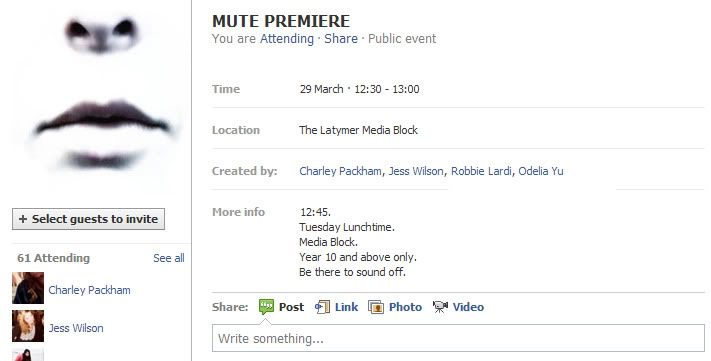
We deliberately put little information on the page, including only vital details like time and location, for enigma and to make our audience come to our screening to see what it was all about.
Evaluation Question 6
6. What have you learnt about technologies from the process of constructing this product?
Hardware:
- Video Camera
- Tripod
- Pag Light
- Microphone
- Headphones
Software:
- Adobe Premiere Pro
- Adobe After Affects
- LiveType

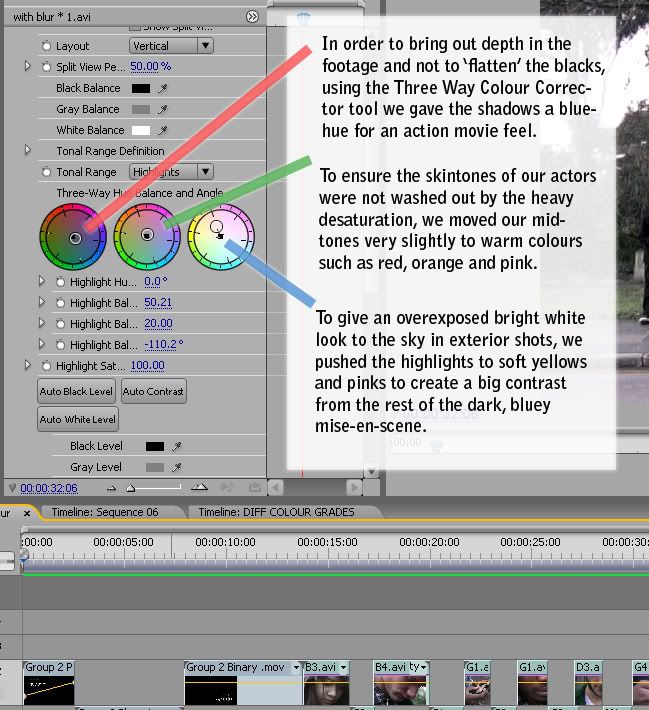
I progressed in my use of sound equalising and non-linear editing and also learnt how to effectively colour grade using ProCamp and Three-Way Colour Corrector which was definitely the biggest challenge, as we were only really using trial and error and we weren’t really sure what colouring we had in mind which made it difficult to know what to do.
Here is a video to demonstrate the kinds of effects we tried on our sequence before deciding on the final setting:
We also put in a high-pass sound effect for when Ava removes her headphones to make it sound as realistic as possible before the music stops completely.
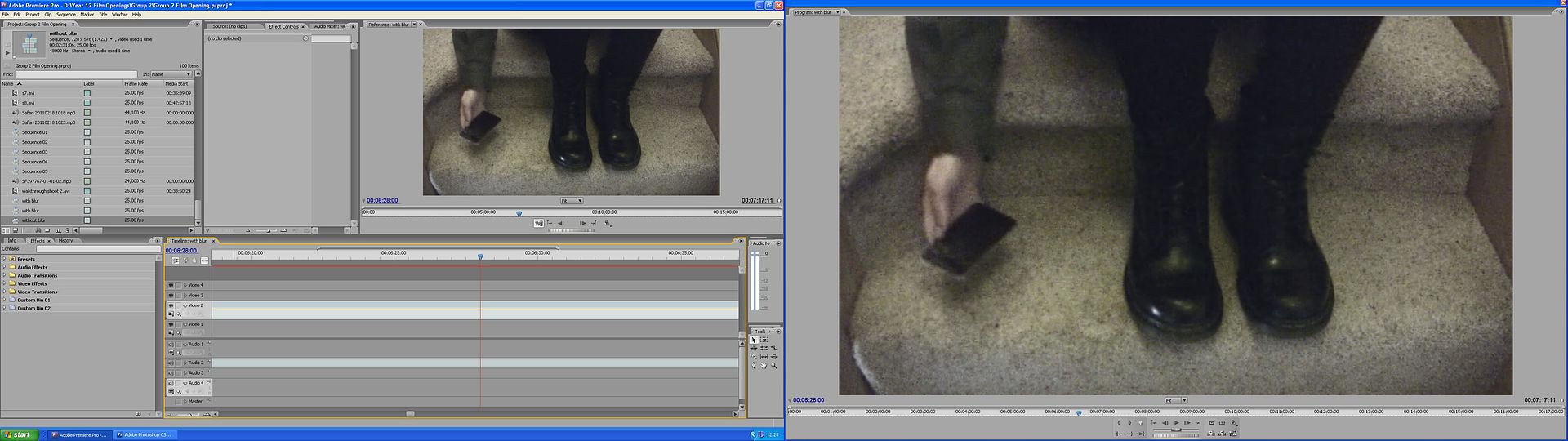 | ||
| BEFORE |
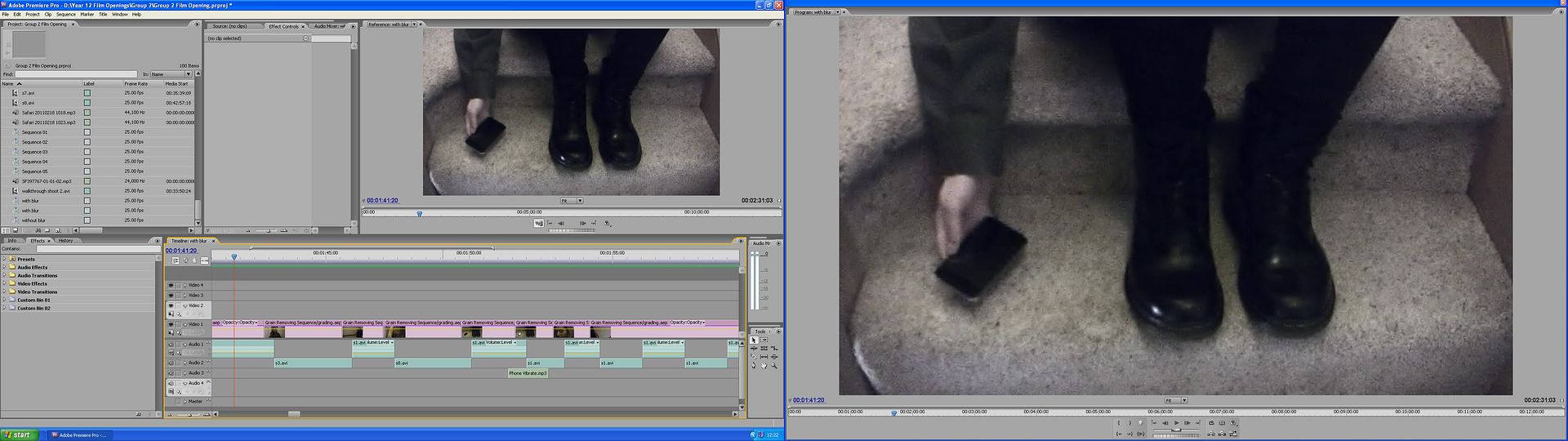 |
| AFTER |
Here is a video of us practicing using focus pulls:
Evaluation Question 7
The titles and opening of a new fiction film, to last a maximum of two minutes. All video and audio material must be original, produced by the candidate(s), with the exception of music or audio effects from a copyright-free source.
 |
| An example of one continuity error we faced |
|
| Master/Establishing Shot |
 |
| A basic continuity error in the Prelim Task |
This helped us when planning our second shoot for our main task as we did a walkthrough of the extra footage we intended to film at school to flag up any possible problems and to help us decide the shot types for our storyboard:
Thursday, 24 March 2011
Final reflections on my finished opening sequence

 |
| On location |
Thursday, 10 March 2011
Research: Popular Action & Drama Films
I looked at IMDB to find out the most popular action and drama films ever released.

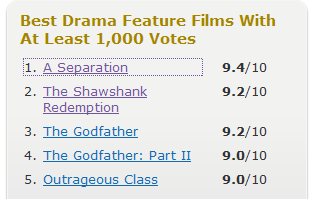
Looking at stills and watching the trailers of some of these films helped me to understand what a good Action/Drama film should look like.
Saturday, 12 February 2011
Shoot Number 1 Preparation
My group is heading out on our first shoot tomorrow, so here's everything I need to bring along:
- Phone
- iPod touch
- Props to dress the room
- Digital Camera & Accessories
- Video Camera
- Food
 |
| Here are some props I brought from my room to help turn Robbie's bedroom into a girl's bedroom. |
 |
| I also found this t-shirt which I thought we could place somewhere in the bedroom as it hints at Ava's want and need to speak her feelings with a voice she doesn't possess. |
Thursday, 20 January 2011
Initial Idea for Coursework Project
My coursework group consists of myself, Charley Packham, Odelia Yu and Robbie Lardi.
At our first meeting, we brainstormed as a group and came up with the starting point of a Psychological Thriller.
We decided it would be best if each of us came up with one initial idea to bring to the next meeting. I liked the idea of the opening sequence consisting of hallucinations, and was inspired by Black Swan, a film I had recently watched at the cinema.

 |
| Rivalry between Nina and Lily in Black Swan |
Here is my initial idea:
The film:
- Psychological Thriller
- Protagonist: An overacheiving teenage schoolgirl who strives to be the best at everything she does
- She ends up killing her rival in a classroom after the protagonist decides she is too much of a threat to her getting into the college she wants to go to, as the college will only take one person from their school
The opening sequence:
- A scene from near the end of the film
- Set in a locked classroom
- The protagonist is sitting at a desk at the back of the room having just killed her rival (the audience does not know this)
- She hallucinates various people appearing in the room and taunging her - e.g. her mother telling her she is a disappointment, her teacher telling her she has failed everything, her rival boasting
- Her hallucinations are interrupted by a knock on the door, then a ratlling of the handle and someone calling the protagonist's name
- Cut to black
Wednesday, 20 October 2010
Prelim Task Evaluation Questions


- Todorov's Theory of Equilibrium - There is an equilibrium with Sam perfectly happy, sitting in his chair, then Philippa comes in and disrupts the equilibrium.
- Principles of Continuity - We followed the 180 degree rule throughout our sequence. We actually filmed a shot that broke the rule, and once in the sequence it didn't flow properly and looked confusing so we decided to remove it. We also used match on action, in particular between the two shots of Philippa sitting down, meaning we edited the two together to make it look like one flowing movement. We also incorporated shot/reverse/shot to film the conversation between the two characters, editing together multiple OTS shots to make the conversation flow.


Thursday, 14 October 2010
Research: Barthes Codes in Film Openings (Dorian Gray)
2. Identify the enigma codes within the opening - what kinds of questions are posed and how is the audience meant to read these codes?
3. Identify key characters and think about what they represent in the opening
4. Interpret the cultural codes in the opening. What kind of knowledge is being drawn on? social/historical/political/art and culture etc. Highlight the 3 most important references in the opening that help with audience understanding.
5. Identify key themes and analyse how they are presented visually/technically.
Friday, 8 October 2010
Research: Continuity in film clips (Inception)
Inception (2010)
Tuesday, 5 October 2010
Research: Levi-Strauss's Theory of Binary Opposites (10 Things I Hate About You)
10 Things I Hate About You (1999)
1. What is the genre of the film? How are the genre signifiers introduced?
This film is a High School Romantic Comedy. We can tell this by the cheery pop music used with the colourful titles at the very beginning of the film. The first characters we see are a group of teenage girls looking over-the-top happy and dancing in their open-top car, which we would expect to see in a romcom aimed at teenagers. The soundtrack then changes to a rock song, Bad Reputation, which clearly fits with the rebellious teenage girl we are introduced to next. All the girls are quite stereotypical - the cheery, girly girls and the lone, miserable-looking rebel - which fits with the conventions of this kind of film, and the way the girls look at each other in quite a bitchy way suggests that this film is a lot to do with cliques and social statuses, another key genre signifier. The next scene clearly shows a high school, and a boy shows a new student around the school whilst talking him through all the different cliques at the school, which is very stereotypical of this genre. There is also of course the classic 'love at first sight' moment with Joseph Gordon-Levitt's new student character and the typical blonde queen bee of the school.
2. Who are the main characters and how are they opposed?
There are a few main characters in this film: Kat, Patrick, Bianca and Cameron. Bianca is the pretty, popular good-girl, Kat is her rebellious older sister, Cameron is the new boy and Patrick is the mysterious 'bad-boy'. The first binary opposite we see (1:06 mins) is the group of girly, perfectly groomed, dancing girls listening to pop music in their car, in contrast to Kat pulling up in her car, on her own, listening to loud rock music ('I Don't give a damn about my reputation...') dressed in dark clothing and looking pretty miserable. The way the camera slowly pans across the screen from the girls in the first car to Kat really emphasises the contrast between them. The next binary opposite (2:42 mins) is between Cameron and Patrick. Cameron has just been shown as quite a nervous, stammery, innocent character, and when he rushes to leave the school office he comes face to face with Patrick, who is much taller and bigger-built than him. Patrick stares at him, looking tough, whereas Cameron is jittery, looks quite startled by him, and nods at him nervously before stumbling out. We are then shown a lot of binary opposites between all the different cliques around the school. There is another strong contrast (5:41 mins) between Kat and the rest of her fellow pupils in her class, shown when she voices her strong opinions that no-one else seems to agree with, especially when one girl describes Hemingway as 'so romantic' and Kat argues back that he was actually 'an abusive, alcoholic misogynist'.
3.What are the main themes of the film and how are they introduced?
One of the main themes will most likely be Cameron's attempt to get Bianca to go out with him, as we can guess by the way he seems to be enchanted by her as soon as he sees her that he won't just forget about her and not bother, despite being told that she is way out of his league and that she can't date anyway. This will of course involve one of the main themes of Romance, and probably Comedy too. There is also the theme of Rebellion, and Non-comformity, as we can tell that Kat is very outspoken with strong opinions, and the viewers will want to know whether she will stay like that throughout the film or maybe change her ways. We also wonder how Patrick will come into it, as he is introduced as a main character but he hasn't really had any connection with any of the other characters yet, although because he seems like such a strong character, we want to know more about him and what will happen to do with him and the other characters. The audience will probably guess that Kat and Patrick will have some kind of romance, as they are both shown as rebellious, non-comforming characters.
4. How is the narrative organised to show conflict?
The narrative deliberately flows straight from the girly-girls in their car to Kat in her car to show the difference between them, and these differences, plus the way they look at each other in an unfriendly way and Kat's outspoken attitudes, suggests that there will be a conflict between Kat and some of the other girls in her school, even if it's not necessarily these particular girls. The sudden switch of the music also shows conflict between their opinions and tastes. We already see conflict between Kat and her teacher, as well as Kat and Joey (a boy in her class) when she argues with them about literature.
Monday, 4 October 2010
Research: Principles of Continuity
From reading the notes I have learnt a lot of different continuity techniques and rules, and they will be extremely useful to me and my group when it comes to shooting my film opening sequence, as it will look much more professional and effective. I broke a lot of continuity rules whilst filming for the 'accident task' but I didn't even know the rules existed, so now I know I won't be breaking them again, unless intentionally for effect. Here are some of the things I've learnt...
Camera directions and techniques create different effects when filming, and directors use a full range of shot distances. For example:
- Close-Ups for emotion, shock value, to put the audience right in the action, to focus on something important
- Mid range for dialogue, action and for linking shots
- Long range to establish a scene or to show large scale action
- OTS shots to place us on the side of a character and empathise with them
- Camera movement to create the effect of physical movement
- To cut the film down to the required length
- To remove unwanted material and mistakes
- To change the order of shots and the way events are portrayed
- To establish a particular style for the production
- Cuts to vary pace and rhythmn
- Fades
- Dissolves to slow time down or link action in different time frames (eg. dreams, flashbacks, etc.)
- Wipes
THE 180 DEGREE RULE

THE 30 DEGREE RULE
Don't change the camera angle by less than 30 degrees within the same framing, or viewers may notice a visible 'jump' in the footage known as a jump cut.
EYELINE MATCHING
The direction of the characters' gazes must stay the same.
MATCH ON ACTION
Movement should be edited so that the character has clearly moved between shots otherwise the action will appear as if it's been repeated.
SHOT/REVERSE/SHOT
When filming two characters talking to each other, film a master shot, then film again close to one character and again close on the other character, allowing you to cut between these three different shots throughout the conversation.
SHOT ORDER
Edit together certain shot distances for a smooth narrative, or it may seem jumpy, for example a CU to a LS may not flow very well in a conventional sequence.
There are many different techniques used in the editing room once the film has been shot:
- Transitions are used to link shots together and make the audience make sense of the film the way you intend them to.
- Sound is added, for example diagetic sound (sound effects), non-diagetic sound (not part of what's on screen eg. music) and a sound bridge (used to link two scenes).
- Lighting can be high-key, low-key for dramatic contrasts, from below to make a subject appear threatening or backlighting to produce a 'halo' effect around the edges of a subject.
- Colour can be edited, for example cold/blue lighting can signify alienation or coldness, whereas warm/yellow lighting can signify comfort and warmth. Very intense colours are describesd as saturated, and sepia or black and white effects can be used to represent a scene set in the past.
Sunday, 3 October 2010
Research: Todorov's Theory of Equilibrium (Snow White)
Snow White (1937) [Up to 8:00 mins on the clip]
1. Who are the agents: the protagonist (the main hero who propels the narrative forward) and antagonist (opposing agent).
Our protagonist is of course Snow White, the beautiful, innocent titular character of this classic Disney film, and the antagonist is The Queen, who is the first character we are shown in the opening sequence.
2.Describe the Equilibrium. How is it represented? What kind of camera shots can you identify? (e.g establishing shots to create a sense of space or use of CUs/cutaways to emphasise particular objects/characters faces). Pick out 2 or 3 examples. Describe the mise-en-scene: what meanings do the props/costumes/lighting/framing carry?
The equilibrium is Snow White, living peacefully, clearly quite content with her life as it is by the way she is singing happily. The Queen is also living separately, content with knowing that she is the fairest of them all. We can see a contrast between the two characters by the way that the Queen is in a very dark, eerie looking castle, then it changes (with a fade rather than a cut, but that might be more to do with the technology or conventions at the time rather than for effect) to a bright, outdoor location with lots of white (symbolising peace and purity) where Snow White is sitting. The Queen is wearing more extravagant clothing, in rich purple, the colour of royalty, with a harsh-looking pointed crown and over the top dark makeup, whereas Snow White is in very simple, muted clothing and is drawn with a much more natural beauty. The differences between the two agents are also underlined by their facial expressions: Snow White has a constant smile on her face whilst the Queen is scowling throughout her scene.
3. Is the Disruption or Disequilibrium introduced or hinted at? (e.g the serial killer in "Seven" is introduced in the title sequence).
The suggestion of what will be the disruption of the equilibrium is introduced at the beginning of the film, when the Queen is told by her mirror on the wall that Snow White is now the fairest of them all, rather than the Queen herself. We can tell that the Queen doesn’t like being second by her outrage at this revelation, and when she clutches her hand and gasps, “Snow White!” we guess that she is now going to try and get her revenge on her, therefore disrupting the equilibrium of peace between the two characters.
4. Are there any visual/verbal/aural clues that hint at what the hero's journey might be? (e.g having to solve the murders within a time-limit of seven days in "Seven")
From the Queen’s reaction to finding out that Snow White is fairer than her, we assume that the hero’s journey will be something to do with escaping the Queen’s revenge on her, and attempting to thwart her plans to become the fairest of them all once again. We are also introduced to a handsome prince riding by on a horse, so we can also guess that her journey will have something to do with the prince, either teaming up with him to defeat her or trying to overcome the Queen’s evil to be together. Because it is an old-fashioned classic fairytale, it is likely that it will actually end up with the prince saving Snow White himself. At the end of the clip we see the Queen ordering a hitman to kill Snow White, so escaping death or capture by the Queen will probably be the main journey Snow White has to go through in the movie.
5. From your knowledge of the film, how will the equilibrium be restored and what will be the new equilibrium?
Having watched many classic Disney movies and fairytale before, the viewer will probably guess that the equilibrium will be restored by the death of the Queen, leaving Snow White and her prince to live happily ever after. This is of course what happens, when the Queen falls off of a cliff at the hands of the Seven Dwarves, then the prince kisses Snow White to bring her back to life.


